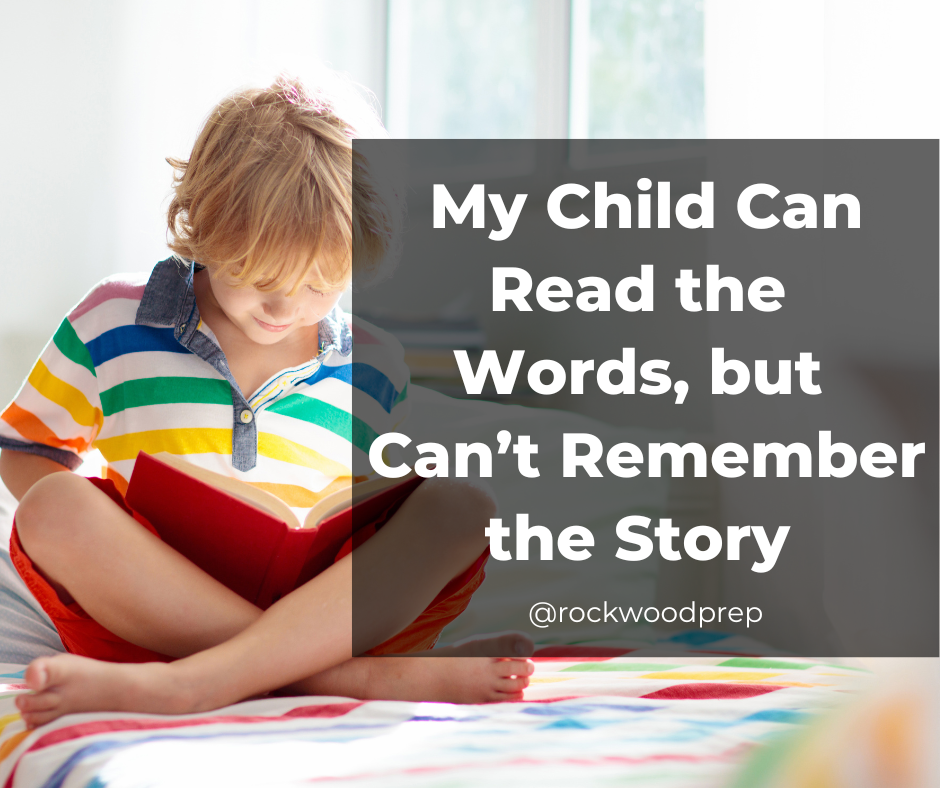
Your child finishes reading all the words on the page aloud. They pronounced the words correctly, paused at the punctuation, and maybe even sounded like a confident reader.
Then there is the blank stare of uncertainty. Is it a reading comprehension problem?
For parents and teachers, this can be confusing. If a child can read the words, why can’t they understand what they just read? The answer is that reading and reading comprehension aren’t the same skill.
Reading comprehension requires children to take the words on the page, understand their meaning, connect ideas, remember important details, and make sense of the bigger picture.
For children who struggle with reading, the good news is that comprehension is a skill that can be practiced and learned. A few simple reading comprehension strategies that are found in the article can make a big difference.
Start With This: Where is the Break Down in Reading?
Before assuming a child needs to try harder, it helps to determine what’s making comprehension difficult. Some children devote so much mental energy to sounding out words that they have little attention left for understanding the story.
Other children read fluently but struggle with vocabulary, working memory, attention, sequencing, or language processing.
Children with dyslexia, ADHD, autism, and other learning differences may encounter these challenges, but reading comprehension difficulties can affect any student. The best strategy depends on discovering where the child is getting stuck.
Here are seven great strategies that you can start right away to help your struggling reader comprehend and enjoy reading.
1. Read It Again… with a Purpose
Children are constantly told to “read it again,” but simply repeating the same paragraph doesn’t always improve understanding. Instead, give your child something specific to look for in the text.
Find something about the character that’s funny or sad. Or ask your child to read the story one more time while looking for the most important sentence.
Now re-reading has a purpose. When you child knows what information their brain should be looking for, it’s easier to find.
2. Think Out Loud
Strong readers do much more than read words. They’re constantly thinking, questioning, predicting, and making connections with the words. Parents and teachers can demonstrate this by thinking out loud while reading.
Here’s an example:
“That’s interesting. He says he isn’t afraid, but he keeps backing away from the door. I wonder if he’s actually scared.”
You’re showing the child what reading comprehension sounds like inside a reader’s head. Eventually, you can encourage your child to do the same by asking, “What are you thinking right now?”
3. Make a Movie in Your Head
Visualization can help turn words into something meaningful. After reading a description, ask your child to close their eyes and imagine the scene.
What does the room look like? What is the character wearing? Is it sunny, dark, noisy, or quiet?
TIP: You can also ask children to draw what they pictured. This can be especially helpful for visual learners because it makes an abstract reading task more concrete.
4. Stop and Predict
Don’t wait until the end of a chapter to talk about it.
Stop occasionally and ask your child what they think will happen next.
Then add the more important question: “What did you read that makes you think that?”
Predicting encourages children to connect what they’ve already learned with what might happen next. Asking for evidence teaches them to return to the text rather than simply guessing.
5. Break Reading into Smaller Pieces
Sometimes the problem isn’t reading comprehension itself. The child may simply be overwhelmed by the amount of information they’re trying to process.
Instead of reading five pages and answering questions afterward, try reading one or two paragraphs at a time. Pause and ask the child to explain what happened. Then continue.
As comprehension and confidence improve, gradually increase the amount of reading between pauses.
6. Try Using Identifiers: Somebody–Wanted–But–So–Then
When children have trouble identifying the important parts of a story, this simple strategy can help them organize their thoughts:
Somebody: Who is the story about?
Wanted: What did they want?
But: What problem got in the way?
So: What did they do about it?
Then: What happened?
For nonfiction or informational reading, simplify it to questions such as: What is this about? What did I learn? Why is it important?
You’re not trying to get them to remember every detail, but you do want them to pull out the information that matters.
7. Ask Your Child to Teach You
Comprehension practice is never fun when it feels like an interrogation. So, stop firing off questions about characters, settings, dates, and details. Instead, try saying:
“Tell me what you think is happening.”
Or even:
“Pretend I haven’t read this. Explain it to me.”
Teaching someone else forces the brain to organize information. It also gives parents and teachers valuable clues about exactly where understanding may have broken down.
U.S. Reading Statistics
Fourth Grade: Around 40% of U.S. fourth graders score below the basic reading level on national assessments, and roughly 65% read below proficient levels.
Eighth Grade and High School: About one-third of eighth graders underperform on reading benchmarks, and only about 37% of high school graduates read at a proficient level.
Secondary Educators’ Views: 58% of middle and high school teachers report that 25% or more of their older students struggle with basic reading and comprehension skills.
Try This Tonight
Choose one page from whatever your child is currently reading.
- Read: Have your child read a short section.
- Pause: Ask, “What are you picturing or thinking about?”
- Retell: Ask your child to explain what happened in their own words.
That’s it.
You don’t need a worksheet or a long list of comprehension questions. The idea is to help your child begin actively thinking about what they read.
A child who repeatedly struggles to understand what they read may eventually decide that they are bad at reading. That’s why building comprehension is also about building confidence.
Instead of focusing only on correct answers, give children strategies they can use when reading stops making sense. Teach them to pause, reread, visualize, ask questions, make predictions, or break the text into smaller sections.
At our school we understand that children don’t all learn in the same way. Small class sizes and individualized support give neurodivergent students and children with learning differences opportunities to develop reading skills at a pace and in a way that works for them.
If your child is struggling with reading comprehension, confidence, or other aspects of learning, call Rockwood Prep Academy at 48-530-0886 to learn more about our supportive approach to education.
Other Helpful Articles
Super Readers are Created, Not Born