You ask the right questions and then wonder, is it an auditory processing disorder? So, let’s say that your child comes home from school and you ask what they learned that day.
“Nothing.”
You try another question. “What did you do in science?”
“I don’t know.”
It can be easy to assume your child simply doesn’t want to talk about school. But what if they have difficulty finding the right words, organizing their thoughts, remembering verbal information, or explaining an event in the correct sequence? Could it be an auditory processing disorder?
Speech and language difficulties don’t always look like obvious communication problems. Sometimes they show up in the classroom as trouble reading, writing, following directions, completing assignments, making friends, or keeping up with a conversation.
That’s because communication isn’t separate from learning. For many children, it’s one of the foundations that makes learning possible.
Speech and Language Aren’t the Same Thing
Parents often use the terms speech and language interchangeably, but there is an important difference when it comes to an auditory processing disorder.
Speech involves producing sounds and words clearly. A child with a speech disorder might have difficulty pronouncing certain sounds, stutter, or have difficulty coordinating the sounds necessary to form words.
Language is broader. Receptive language refers to a child’s ability to understand what they hear or read, while expressive language is the ability to use words and sentences to communicate thoughts, needs, and ideas.
A child can pronounce every word beautifully and still struggle with language.
For example, they may have difficulty understanding a teacher’s instructions, learning new vocabulary, answering questions, putting their thoughts into words, or telling a story in a logical order.
The National Institute on Deafness and Other Communication Disorders (NIDCD) explains that developmental language disorder (DLD), for example, can affect speaking, listening, reading, and writing. Approximately 1 in 14 kindergarten-age children has DLD.
The Connection Between Language and Learning Disabilities
The connection between language and learning disabilities becomes particularly important once children begin learning to read and write.
The American Speech-Language-Hearing Association (ASHA) notes that spoken language provides a foundation for reading and writing and that children with spoken language disorders frequently experience difficulty learning these skills.
Think about everything a child has to do during an ordinary school day. They must listen to instructions, understand vocabulary, remember information, ask questions, explain ideas, recognize sounds within words, read sentences, understand what they read, and organize thoughts well enough to put them on paper.
When one or more of those underlying language skills is difficult, academics can become difficult too.
This overlap can occur with several different learning and developmental conditions.
Dyslexia primarily affects reading and spelling, but spoken and written language skills are closely interconnected. Some children who struggle with reading also experience other language difficulties.
Children with autism spectrum disorder have widely varying communication profiles. Some may experience challenges with receptive or expressive language, while others may speak fluently but need support with social or pragmatic communication, such as interpreting conversational cues or understanding how language changes depending on the situation.
Children with specific learning disorders may struggle with reading, written expression, spelling, or mathematics. Language difficulties can make some of these challenges even harder. For example, a student may understand basic math calculations but become confused by a word problem because interpreting the language is the real obstacle.
What About Auditory Processing Disorder?
Some children seem to hear perfectly well but have particular difficulty making sense of spoken information, especially when the classroom is noisy or instructions are complicated.
This may raise questions about auditory processing disorder (APD). However, APD shouldn’t simply be assumed when a child struggles with listening.
Hearing, attention, language comprehension, and auditory processing can produce overlapping difficulties. If APD is suspected, families may need an audiologist as part of the evaluation process. A speech-language pathologist can assess speech and language abilities and collaborate with other professionals to determine where communication is breaking down.
Hearing problems should also be considered. According to NIDCD, hearing loss is one possible cause of delayed speech or language development.
Sometimes a Communication Problem Looks Like a Behavior Problem
Imagine that a teacher says:
“Finish the last three questions, put your paper in the blue tray, get your reading book, and meet your group at the back table.”
Most students begin moving.
One child stays in their seat.
Are they refusing to listen? Were they distracted? Or did they have difficulty processing and remembering a multi-step verbal instruction?
Children don’t always know how to explain, that they don’t understand what you’re asking me to do.
Instead, they may say “I don’t know,” copy another student, avoid the assignment, become frustrated, make jokes, shut down, or refuse to participate.
NIDCD specifically notes that language difficulties can sometimes be misinterpreted as behavioral problems. A child may not follow directions because they don’t fully understand them, or communication frustration may contribute to acting out.
Over time, these experiences can affect more than grades.
A child who has difficulty expressing themselves may stop raising their hand. Someone who can’t keep up with conversations may withdraw from peers. A child who is frequently corrected for pronunciation, reading, or grammar may begin to believe they’re simply bad at school.
Communication difficulties can touch learning, friendships, independence, confidence, and self-esteem.
How Children Benefit from a Speech and Language Evaluation
Children develop at different rates, and one difficulty doesn’t automatically mean that a child has a speech, language, or an auditory processing disorder.
However, parents may want to talk with their child’s teacher, pediatrician, or a speech-language pathologist if they consistently notice concerns such as:
- Difficulty pronouncing words clearly
- Trouble understanding or following age-appropriate directions
- Limited vocabulary or difficulty learning new words
- Trouble finding the right words when speaking
- Difficulty explaining ideas or telling stories in sequence
- Frequent misunderstanding of questions or conversations
- Difficulty with rhyming, sounds within words, reading, spelling, or writing
- Frustration or withdrawal when communicating
Don’t overlook hearing, either. A hearing evaluation may be appropriate when a child frequently misunderstands spoken information or there are concerns about hearing.
What a Speech-Language Pathologist Does
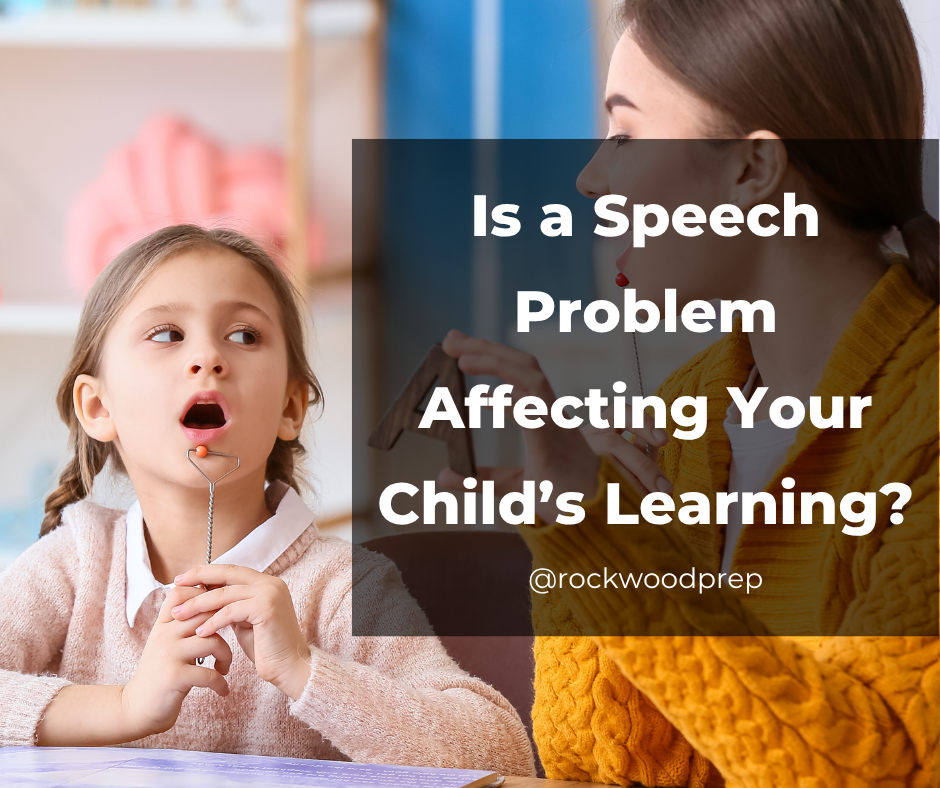
A speech-language pathologist, or SLP, does much more than help children pronounce sounds correctly.
SLPs are trained to screen, assess, diagnose, and treat speech and language disorders. Depending on a child’s needs, an SLP may evaluate speech sounds, receptive and expressive language, vocabulary, grammar, phonological awareness, social communication, and literacy-related language abilities.
A comprehensive evaluation isn’t based on one observation. It may include developmental and medical history, parent and teacher input, classroom information, observation, formal and informal assessments, and a hearing screening or referral when appropriate. ASHA also recommends considering literacy because of the established connection between spoken and written language.
Once a child’s strengths and areas of difficulty are understood, speech therapy can target specific communication skills and provide strategies that can be practiced at school and at home.
How Parents Can Support Communication at Home
You don’t have to turn family time into therapy sessions.
Read together and talk about what happened in the story. Give your child enough time to answer instead of immediately finishing their sentences. Introduce new vocabulary naturally. Ask questions that require more than yes-or-no answers, and encourage your child to explain how they completed a project or solved a problem.
Most importantly, try not to equate difficulty communicating with a lack of intelligence.
A child can have wonderful ideas and still have trouble putting those ideas into words.
When Learning and Communication Support Come Together
For children with learning differences, treating communication, academics, and classroom success as completely separate issues can miss part of the picture.
At Rockwood Prep Academy in San Tan Valley, Arizona, small class sizes and individualized learning help educators better understand how each student learns and communicates. The school is designed to support neurodivergent learners, including children who may struggle in a traditional classroom environment.
RWP has access to speech therapists, giving students access to additional communication support when appropriate. Having educational and supportive services available in a school environment can make it easier to look at the whole child, including how communication abilities may be affecting academic progress, confidence, and social development.
A child who struggles to communicate doesn’t necessarily have less to say. They may simply need another way to learn how to say it, understand it, read it, or write it.
If your child is struggling with communication, learning, or both, call Rockwood Prep Academy at 480-530-0886 to schedule a tour of the San Tan Valley campus and learn more about its individualized approach to education.