
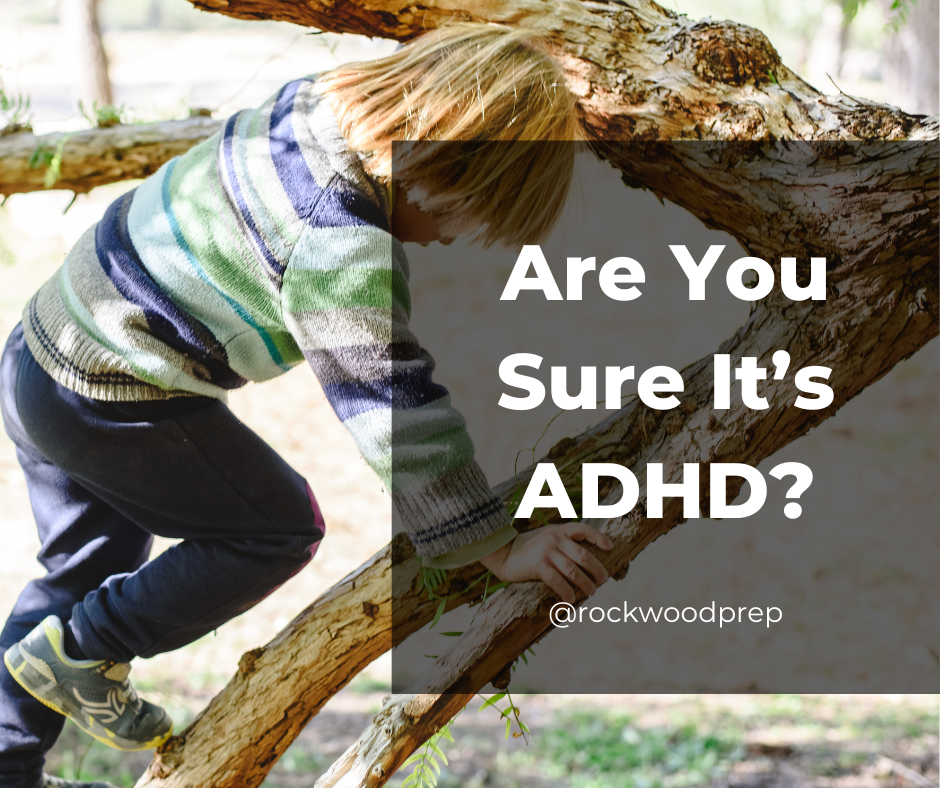
Your child’s teacher tells you that they can’t sit still during class and it could be ADHD. After school, homework that should take 20 minutes stretches into an hour or more. You already know that you child is constantly distracted and they interrupt, forget instructions, stare out the window, avoid assignments, or seem to have endless energy.
Eventually, the question comes up: “Have you had your child tested for ADHD?”
Attention-deficit/hyperactivity disorder (ADHD) is a very real neuro-developmental disorder, and getting an accurate diagnosis can be an important first step toward helping a child succeed. That’s because difficulty paying attention, impulsive behavior, or hyperactivity doesn’t automatically mean a child has ADHD.
In fact, several other challenges can look surprisingly similar.
TIP: According to the Centers for Disease Control and Prevention (CDC), there is no single test that diagnoses ADHD.
Sleep disorders, anxiety, depression, and certain learning disabilities can produce symptoms that resemble ADHD. Some children with ADHD also have one or more of these conditions at the same time.
Parents: The important question is more than, “Does my child have ADHD?” but rather, “What is making it difficult for my child to learn, focus, or manage their behavior?”
What Else Can Look Like ADHD?
Imagine a child who repeatedly gets out of their seat during reading. They ask to sharpen their pencil, then they need a drink, or they keep talking to the student next to them.
It could be ADHD.
But what if that child has dyslexia and reading is incredibly difficult? Avoiding the assignment may have become a way to cope with frustration or embarrassment.
A similar pattern can occur with math. A child struggling to understand the material may appear distracted, disruptive, or uninterested when they’re actually overwhelmed.
Other possibilities can include anxiety, depression, learning or language disorders, autism, oppositional defiant disorder (ODD), sensory needs, sleep problems, stress, or other emotional and behavioral challenges. The American Academy of Pediatrics recommends screening children being evaluated for ADHD for several coexisting conditions, including anxiety, depression, ODD, learning and language disorders, autism spectrum disorder, and physical conditions such as sleep apnea.
Impulsivity also deserves some clarification. Impulsive behavior isn’t necessarily a separate explanation for ADHD-like behavior because impulsivity is one of ADHD’s core symptoms. However, children can struggle with impulse control and emotional regulation for different reasons.
This is why looking beyond the behavior matters.
Sometimes “I Won’t” Means “I’m Struggling”
Children don’t always have the words to say that they can’t read as well as everyone else, or that they’re worried that they’re going to get the answer wrong. Some children are distracted because there is so much happening in this classroom that they can’t concentrate.
Instead, parents (and sometimes teaches) only see the behavior.
A child may shut down, become silly, argue, wander around the classroom, rush through an assignment, or refuse to begin.
“Challenging behavior shouldn’t simply be ignored. It means that we need to understand the “why” behind the behavior so we can help parents choose better supportive strategies.” -Marci Gabriel, CEO, Rockwood Prep Academy | ABA Connections
The same child who cannot concentrate for ten minutes on a worksheet may spend considerable time building a LEGO creation or completing an activity they enjoy. That observation alone neither proves nor rules out ADHD, but patterns like these provide valuable information for parents, teachers, and healthcare professionals.
Before You Assume It’s ADHD, Look for Patterns
If you’re concerned about your child’s attention or behavior, start by taking notes. Instead of simply writing down that your child couldn’t focus, look at what was happening before, during, and after the lack of focus.
Here are some other questions to ask yourself that could reveal patterns about your child’s behavior:
- Does the behavior occur both at home and at school?
- Does it happen during particular subjects, such as reading or math?
- Is your child getting enough quality sleep?
- Are anxiety, frustration, sensory overload, or emotional difficulties contributing?
- Is there evidence that your child is struggling academically and trying to avoid difficult work?
- Has something recently changed at home, school, or socially?
- Are the behaviors significantly interfering with learning, friendships, or family life?
The answers to these questions can help create a much clearer picture.
How To Get an ADHD Diagnosis in Arizona
For Arizona parents who suspect ADHD, a good starting point is your child’s pediatrician or another qualified healthcare professional.
The CDC notes that ADHD may be diagnosed by a primary care provider. Consider involving a pediatrician or a mental health professional such as a psychologist or psychiatrist. Diagnosis involves multiple steps rather than one definitive test.
Current American Academy of Pediatrics guidance recommends evaluating children and adolescents ages 4 through 18 when they have academic or behavioral difficulties accompanied by symptoms of inattention, hyperactivity, or impulsivity.
An ADHD diagnosis requires evidence that symptoms and impairment occur in more than one major setting. This type of information is typically gathered from parents, teachers, and other professionals involved with the child. Clinicians should also consider whether another condition could better explain the symptoms.
Depending on your child’s needs, an evaluation may also identify reasons to pursue educational, psychological, developmental, vision, hearing, sleep, or other assessments.
All of this evidence isn’t gathered to prove that your child does or doesn’t have ADHD. Instead think of it as understanding what’s making learning, focusing, or managing behavior so difficult for your child.
When It’s Time to Ask for Help
Every child gets distracted, has difficult days, avoids something they don’t enjoy, or occasionally struggles to sit still.
It becomes more concerning when these difficulties are persistent and begin interfering with school performance, relationships, daily routines, emotional well-being, or a child’s confidence.
Don’t wait until your child believes they’re bad at school to start asking questions.
Talk with their teacher. Talk with their healthcare provider. Ask about patterns that other adults may be noticing. If academics are the concern, ask whether additional educational testing may be appropriate.
Most importantly, remember that a diagnosis is information. It isn’t a definition of who your child is and what they can become.
The School Environment May Be Part of the Problem
Sometimes a diagnosis helps families discover something else important: their child needs a different approach to learning.
A large traditional classroom can be difficult for students who need more movement, individualized instruction, additional academic support, fewer distractions, or teachers who have time to understand how they learn best.
At Rockwood Prep Academy in San Tan Valley, Arizona, neurodivergent learners are supported in a smaller-class environment designed to recognize that children don’t all learn the same way.
Individualized learning gives educators opportunities to identify strengths, address areas where a student may have fallen behind, and adapt instruction instead of expecting every child to fit into one educational mold.
Rockwood Prep also offers supportive services including Applied Behavior Analysis (ABA), occupational therapy (OT), and physical therapy (PT), helping families access additional support based on their child’s individual needs.
Whether your child has ADHD, another learning difference, multiple diagnoses, or simply hasn’t been thriving in a traditional classroom, the first step is understanding what they need to succeed.
If you’re wondering whether a different school environment could help your child rediscover confidence and a love of learning, call Rockwood Prep Academy at 480-530-0886 to schedule a tour of the San Tan Valley campus.
Other Helpful Articles
Is it Autism, ADHD, or Dyslexia?
10 Ways to Help Your ADHD Student Get More Dopamine Naturally
Busy Bodies and Focused Minds: Sensory Activities that Help Kids with ADHD

