
Your child desperately wants friends, but social situations are often too much. Your child can spend hours learning everything there is to know about dinosaurs, yet getting started on a 15-minute homework assignment on the same topic feels nearly impossible. These contradictions can be confusing and could point to an AuDHD overlap.
Parents are now learning that there are some children who have both autism spectrum disorder (ASD) and attention-deficit/hyperactivity disorder (ADHD). AuDHD is a trending term used to describe these contradictions.
So, What Does AuDHD Mean?
AuDHD is an informal term combining autism and ADHD. It isn’t a separate medical diagnosis, but it is a convenient way some people are using to describe children who have both autism spectrum disorder and ADHD.
And the overlap isn’t unusual.
FACT: A 2024 school-population study found that approximately 33% of autistic children in the study also met criteria for ADHD. The American Academy of Pediatrics (AAP) has similarly reported that approximately half of children and adolescents with autism may meet diagnostic criteria for ADHD.
This wasn’t always the case. Changes introduced with the DSM-5 has made it possible for clinicians to diagnose ADHD and autism in the same individual.
For parents and educators, understanding that the two can occur together matters because sometimes the characteristics seem to pull a child in completely different directions.
When a Child’s Brain Wants Two Different Things
One of the easiest ways to understand AuDHD is to think about competing needs.
“I need routine—but I get bored with routine.”
Predictability may help an autistic child feel secure and prepared. At the same time, ADHD may create a desire for novelty, stimulation and spontaneity. A child might become upset by an unexpected schedule change but also struggle to follow the same routine day after day.
“I want friends—but socializing exhausts me.”
A child may enthusiastically approach other children, interrupt conversations or talk excitedly about a favorite subject. At the same time, they may have difficulty interpreting social cues or knowing when another person has lost interest. Sensory overload can make busy social settings even harder.
“I need stimulation—but too much stimulation overwhelms me.”
A child might seek movement, noise or excitement and then suddenly reach a point where the classroom, cafeteria or playground becomes too much.
“I can concentrate for hours—but I can’t focus on my homework.”
Attention isn’t always simply about the ability to focus. A child may become deeply absorbed in a preferred interest yet struggle tremendously with starting, organizing or completing a less interesting assignment.
These behaviors can look inconsistent from the outside. To the child, however, both needs may be very real.
ADHD, AuDHD and Autism: What Might Parents Notice?
No chart can capture every child, and these characteristics shouldn’t be used to diagnose ADHD or autism. They can, however, help parents understand how the two sets of traits sometimes interact.
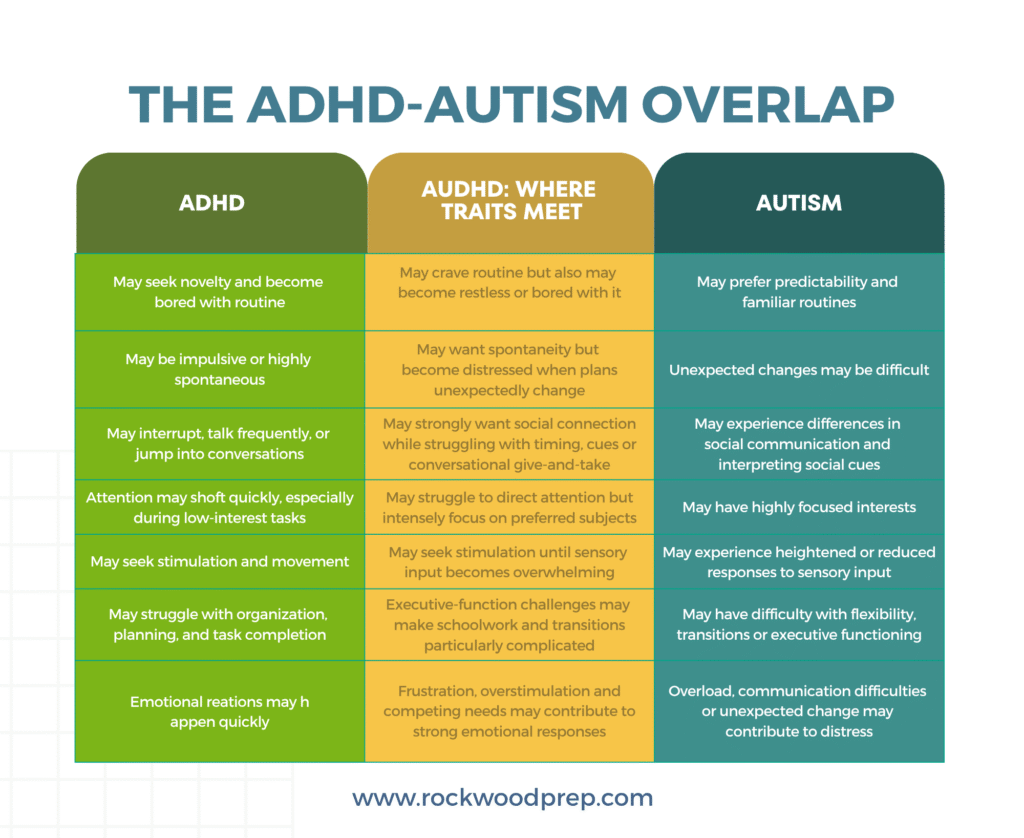
The important takeaway is that AuDHD doesn’t necessarily look like simply adding an ADHD checklist to an autism checklist. The traits can interact. That’s why a child can seem extremely organized about one thing and completely scattered about another. They may be adventurous one day and insist on sameness the next.
Could One Condition Hide the Other?
Sometimes it can. A child’s characteristics may initially appear to fit one diagnosis more clearly than another. The AAP notes, for example, that some children who are eventually diagnosed with autism were first identified as having ADHD. ADHD-related inattention and impulsivity can also further complicate social functioning in autistic children.
This is one reason a thorough professional evaluation can be valuable when a child’s current diagnosis doesn’t seem to explain everything parents and teachers are seeing.
Current ADHD guidelines recommend screening children for co-occurring developmental and behavioral conditions, including autism, learning and language disorders, anxiety, depression and other concerns.
AuDHD Can Come with Strengths, Too
It’s easy to concentrate on what’s difficult when a child is struggling in school. But a neurodivergent brain can also bring a distinctive way of experiencing and thinking about the world.
Depending on the individual child, parents and teachers may notice:
intense curiosity
- creativity and original thinking
- deep knowledge about favorite subjects
- enthusiasm and passion
- persistence when something matters to them
- strong attention to certain details or patterns
- unconventional approaches to solving problems
- honesty and directness
Not every child will have the same strengths, just as every child won’t experience the same challenges. The goal isn’t to turn neurodivergence into a list of superpowers. Instead, we should use it to recognize the whole child instead of defining them by the things they find difficult.
What Helps a Child with Both Autism and ADHD?
There isn’t one AuDHD treatment plan because there isn’t one type of AuDHD child.
Support should begin with a simple question: What is making my child’s day harder than it needs to be?
For one child, it might be sensory overload. For another, starting assignments is the biggest hurdle. Another may need help with emotional regulation, transitions, organization or help making friends.
Supportive strategies could include predictable schedules with some opportunities for choice, visual reminders, breaking large assignments into smaller steps, movement or sensory breaks, additional transition time, organizational support, positive reinforcement, and individualized classroom accommodations.
Behavioral, occupational, speech or other therapies may also be appropriate depending on the child’s needs.
Medication may be considered for ADHD symptoms such as significant hyperactivity, impulsivity or inattention. This is a decision parents should make with their child’s qualified healthcare provider. The AAP recommends looking at behavioral interventions and other factors that may contribute to symptoms as part of an individualized approach to children who have autism and ADHD symptoms.
The goal is to identify what is getting in the way of learning, relationships, independence and confidence, and provide the right support.
Sometimes a Different Learning Environment Makes the Difference
A child who needs structure and flexibility can have a difficult time in a one-size-fits-all classroom.
At Rockwood Prep Academy in San Tan Valley, Arizona, we understand that neurodivergent students don’t all learn, communicate or regulate themselves in the same way.
Small class sizes and individualized learning give educators more opportunities to recognize when a student needs movement, additional explanation, a different approach to an assignment or simply more time to transition. Rockwood Prep also provides supportive services, including ABA, occupational and physical therapy, and speech services, to help address the individual needs of neurodivergent learners.
Whether your child has ADHD, autism, both diagnoses, or is still in the process of figuring out why school feels harder than it should, the right learning environment can make a meaningful difference.
TIP: Children don’t have to learn the same way to love learning.
If your child is struggling in a traditional classroom, consider scheduling a tour of Rockwood Prep Academy to learn more about an educational environment designed to recognize both the challenges and the possibilities, of learning differently.
Other Helpful Articles
Is it Autism, ADHD, or Dyslexia?
When Is it Time to Leave Traditional School?
10 Ways to Build Confidence in Kids with Learning Disabilities

